
Here’s a mix-up that shows up across a surprising number of supplier websites in India: calling a transit-time ultrasonic flow meter a “Doppler” meter. They’re not the same technology, and the difference actually matters for whether the instrument will work on your fluid at all.
What Is an Acoustic Doppler Flow Meter?
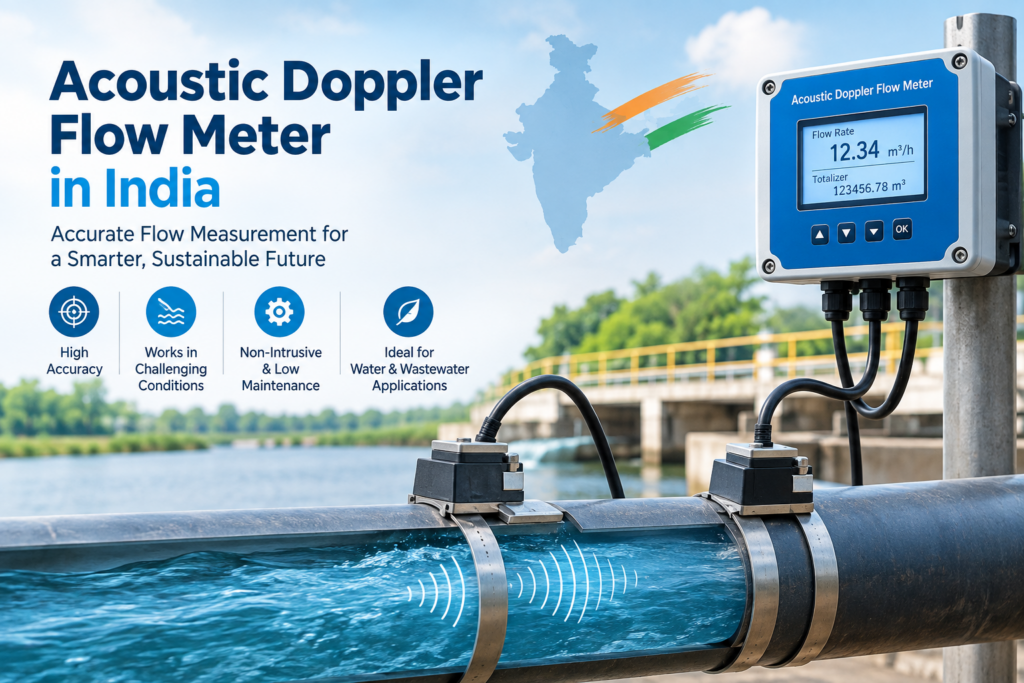
The acoustic Doppler flow meter determines velocity by emitting a high-frequency ultrasonic signal into the fluid and detecting the frequency difference that is produced after the signal gets reflected by an object within the fluid that is in motion – suspended solids, bubbles or particulates. The frequency difference, known as the Doppler Effect (similar to the way the sound of a siren changes when approaching), is directly proportional to the velocity of the fluid.
How It Actually Works and Why It's Not the Same as Transit-Time
This is the point worth getting right, because a lot of Indian supplier content doesn’t: Doppler flow meters need something in the fluid to reflect sound off. Clean, particle-free water doesn’t give a Doppler sensor much to work with the signal has nothing to bounce off, and readings become unreliable.
Transit-time ultrasonic meters work the opposite way. They send signals both with and against the flow and measure the tiny time difference between the two a method that actually works best in clean fluids, because suspended particles interfere with signal transmission rather than helping it.
So if you’re comparing options and see “Doppler” and “transit-time” used interchangeably on a supplier page, that’s worth double-checking before you buy; picking the wrong one for your fluid means unreliable data from day one.
Where Acoustic Doppler Actually Fits Best
Doppler’s real strength shows up exactly where transit-time struggles dirty, particle-laden flow:
Sewage and effluent treatment plants, where influent and sludge lines are full of suspended solids by design. Sugar mill process streams, which routinely carry sediment and process residue. Textile and dyeing effluent, dense with dye particulates and process chemicals. Mining slurry lines, where the fluid is essentially a mixture of water and solids.
If your stream isn’t clean, Doppler isn’t a limitation it’s the correct technology choice.
When Doppler Is the Wrong Choice
The flip side matters just as much: demineralized water, potable water, and other very clean process fluids often don’t carry enough particulate content for a Doppler sensor to lock onto a reliable signal. For those applications, transit-time ultrasonic or electromagnetic flow meters are the better fit.
Open Channel vs Pipe (Clamp-On) Doppler Systems
Two different setups fall under “acoustic Doppler,” and it’s worth knowing which one you actually need. A clamp-on Doppler sensor mounts externally on a pipe for in-line flow measurement no cutting into the pipe required. An open-channel system pairs a Doppler transmitter with a flow computer, calibrated against a weir or flume profile, for canals, drains, and open channels rather than closed pipes. If your application is a covered sewage line, you want the clamp-on version; if it’s an open drain or channel, you want the flow-computer setup.
Why Indian Industries Rely on It for Compliance
Continuous effluent discharge monitoring is a real regulatory requirement for many Indian industries under CPCB norms, and Doppler’s non-invasive, low-maintenance nature no moving parts, no probe sitting in a solids-heavy stream to foul or wear out makes it a practical fit for long-term compliance logging rather than a sensor you’re constantly pulling out to clean.
Key Specs and Installation Considerations
Pipe material matters more than most buyers realize. Clamp-on Doppler sensors couple far better on metal pipe than PVC or other plastics, since the signal has to transmit through the pipe wall itself.
Minimum solids concentration — check the manufacturer’s stated minimum; too clean a fluid genuinely won’t register reliably.
Velocity range — match to your actual flow conditions, not just average flow.
Output type — RS-485/Modbus or 4-20mA for SCADA integration; GSM/GPRS telemetry where the site has no wired connectivity, common at remote effluent or canal monitoring points.
Choosing the Right Supplier in India
The instrument is only as good as the integration around it. AMSET Technology, Pune works across instrumentation selection, SCADA/telemetry integration, and ongoing calibration support which is the difference between a Doppler sensor that logs numbers nobody checks and a compliance-ready monitoring system your team can actually rely on.
Get the technology match right doppler for dirty flow, transit-time for clean and this becomes one of the lowest-maintenance ways to keep continuous, reliable flow data on exactly the streams that are hardest to monitor any other way.
Frequently Ask Question:
Is Doppler the same as transit-time ultrasonic flow measurement?
No. Doppler requires suspended particles or bubbles to reflect the signal and works best in dirty fluids. Transit-time measures the difference in signal travel time with and against the flow and works best in clean fluids. The two are commonly confused on supplier websites but are different technologies.
When should I use a Doppler flow meter?
For fluids with suspended solids or entrained air — sewage, effluent, sugar mill process streams, textile/dyeing effluent, and mining slurry.
When should I avoid Doppler?
For very clean fluids like potable or demineralized water, where there isn’t enough particulate content for a reliable signal reflection. Transit-time or electromagnetic flow meters are better suited there.
Does pipe material affect accuracy?
Yes — clamp-on Doppler sensors couple significantly better on metal pipe than on PVC or other plastics, since the ultrasonic signal has to transmit through the pipe wall.
Is it used for CPCB effluent compliance in India?
Yes — its non-invasive, low-maintenance design suits continuous effluent discharge monitoring required under CPCB norms, without a probe sitting directly in a solids-heavy stream.