
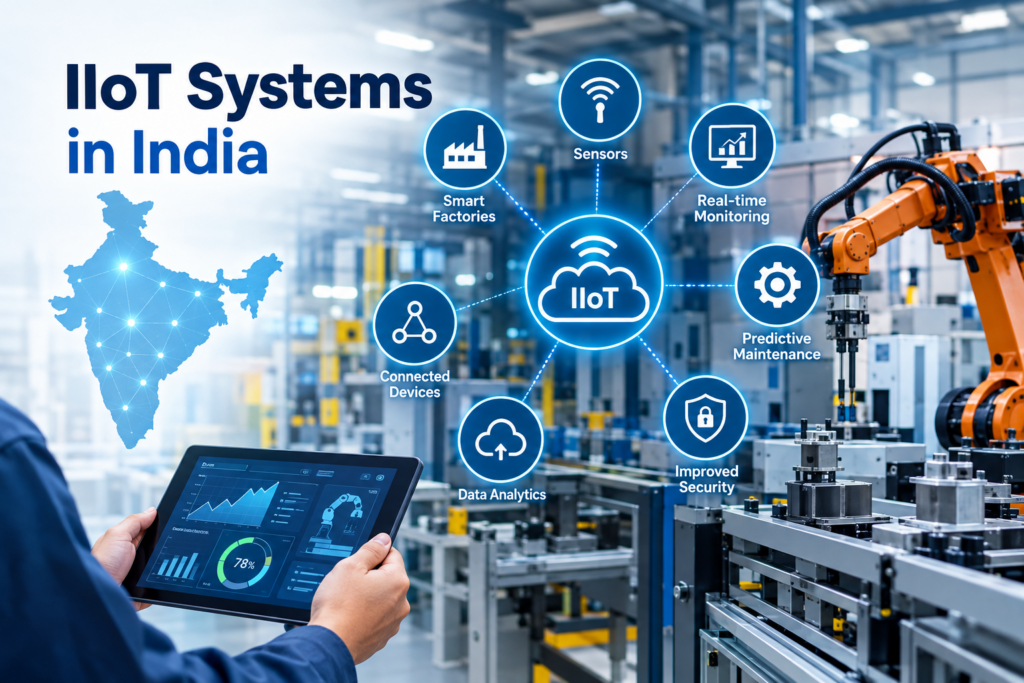
If you have been around any factory setting or water treatment plants in India over the past few years, you may have observed that the machines are starting to speak. Pumps report their own vibration levels. Water quality analyzers send alerts before contamination becomes a compliance problem. Machines flag a bearing wearing out weeks before it actually fails. That’s an IIoT system doing its job quietly, in the background, without anyone standing over a gauge with a clipboard.
IIoT, the Industrial Internet of Things, isn’t a rebrand of consumer IoT for factories. It’s a different category of problem. A smart thermostat failing costs you comfort. A pump failing at a water treatment plant costs a city its supply for a day. The stakes are why IIoT systems are engineered so differently and why India’s version of this story looks nothing like a Silicon Valley pitch deck.
Where India Actually Stands
The numbers back up what’s visible on the ground. India’s industrial IoT market is expanding at roughly a 10.5% CAGR well ahead of the global average of 8.1% and the reasons aren’t abstract. Digital India and Make in India are directly credited as growth drivers, alongside rapid digital transformation across manufacturing. Add the government’s Production Linked Incentive scheme pushing smart manufacturing adoption across manufacturing sectors, and you get a market that isn’t waiting for IIoT to prove itself it’s being pulled forward by policy and by plain economic pressure to cut downtime and waste.
That said, adoption in India doesn’t look like a greenfield rollout. It looks like retrofitting.
How an IIoT System Actually Works
Strip away the buzzwords, and an IIoT system is four layers stacked on top of each other:
Field layer sensors and actuators on the actual equipment: vibration sensors on a pump, turbidity and chlorine sensors on a water line, and current sensors on a motor.
Edge layer a gateway near the equipment that collects this data locally, does basic processing, and decides what’s worth sending onward. This matters a lot in India, where continuous high-bandwidth connectivity to a remote plant isn’t always a given. Connectivity layer protocols like MQTT or OPC-UA carry that data to the cloud, often over a mix of wired Ethernet, cellular, or LPWAN depending on the site. Cloud and dashboard layer where the data becomes a dashboard, an alert, or a trend line an engineer actually acts on.
The part most vendor pages skip is that layer two the edge is where Indian deployments live or die. A lot of Indian industrial sites aren’t building this from scratch; they’re bolting modern sensors and connectivity onto PLC and SCADA systems that have been running reliably, untouched, for fifteen years. Getting new IIoT sensors to talk to that legacy control layer without ripping it out is a harder engineering problem than most “what is IIoT” articles let on.
Where IIoT Is Already Working in India
The manufacturing industry rightly gets all the focus, but other industries deserve special mention because they don’t typically make it into general IIoT discussions. These are the industries that are actually deploying IIoT in India. We focus on the manufacturing industry and its benefits from predictive maintenance of motors, compressors, and pumps because of a particular reason.
Water infrastructure. Continuous water quality monitoring chlorine, turbidity, pH, flow lets a utility catch a contamination event or a pipeline leak in hours instead of days. Pump automation tied into this same system means a dam or irrigation network can be run remotely instead of manually, which matters enormously across India’s spread-out rural infrastructure.
Railways. IoT-based condition monitoring on track and rolling-stock assets vibration, temperature, and load sensors reporting back to a central monitoring system is quietly becoming one of the more mature IIoT applications in the country, precisely because rail infrastructure failure has such visible, immediate consequences.
If you’re only picturing IIoT as “sensors on a factory machine,” you’re missing where a lot of the return on investment is actually showing up.
The Real Barriers, Not the Marketing Ones
Every IIoT explainer online lists “benefits.” Almost none of them mention what actually slows a project down in India:
Legacy Equipment– Most industrial sites aren’t starting from zero; they have working PLC/SCADA systems that need to be integrated with, not replaced.
Connectivity Gaps- Plenty of industrial sites, pump houses, remote dam installations, and rural water treatment plants sit outside reliable high-speed connectivity zones, which is why edge processing isn’t optional; it’s the whole point. Skilled workforce. There’s a real shortage of engineers who understand both the OT (operational technology) side and the IT/cloud side well enough to bridge them.
Cybersecurity and data residency- Connecting a water utility’s control systems to the internet opens a genuine attack surface, and Indian buyers are increasingly asking where their data physically sits. None of this is a reason to avoid IIoT. It’s the reason to pick a partner who’s actually solved these problems before, not just sold the concept.