
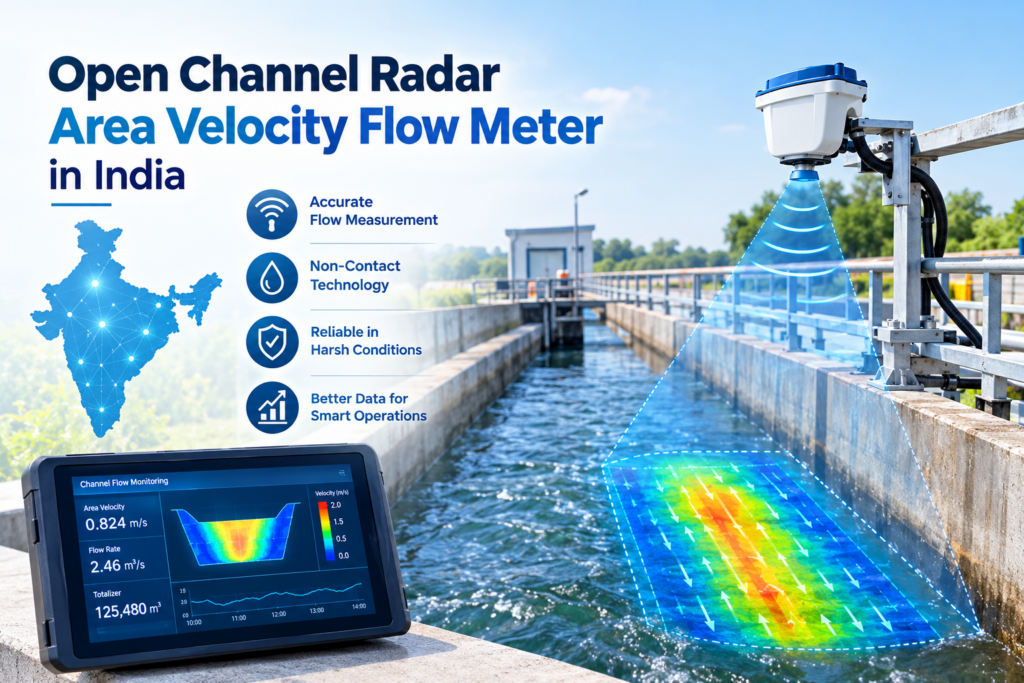
If you’ve ever tried to measure flow in a canal, a stormwater drain, or an effluent discharge channel using anything that sits in the water, you already know the problem: silt clogs it, debris damages it, and monsoon flow speeds tear it loose. That’s exactly the problem a radar area velocity flow meter is built to solve it measures flow without ever touching the water.
What Is an Open Channel Radar Area Velocity Flow Meter?
Open channel flow follows a simple equation: Q = A × V—flow rate equals the cross-sectional area of the water times its velocity. A radar area velocity flow meter measures both halves of that equation from above the channel, using radar instead of a physical sensor in the flow path. No flume, no weir, no submerged probe just a unit mounted on a bracket above the water.
How It Works: Radar Level + Doppler Velocity
The instrument is really two radar functions in one housing. A downward-facing radar beam measures the distance to the water surface, which, combined with the channel’s known geometry, gives you the cross-sectional area. A second radar signal, angled across the surface, picks up the Doppler shift as it reflects off moving water and ripples, giving you the surface velocity. The unit’s controller combines level, velocity, and a pre-configured channel profile to calculate discharge in real time and pushes that out over RS-485/Modbus or 4–20 mA to a logger, RTU, or SCADA system.
Radar vs. Ultrasonic vs. Submerged Sensors—Which One Actually Fits Your Site?
This is the part most product pages skip, and it’s the decision that actually matters:
Radar handles fog, water vapor, steam, and temperature swings without losing accuracy which is exactly why it’s the right call for humid sewer chambers, covered channels, and monsoon-season outdoor sites where condensation is constant. Ultrasonic works well in cleaner, drier environments, but its readings can drift when there’s heavy vapor or condensation near the sensor face, since it relies on sound travel time through air.
Submerged sensors (Doppler probes, mechanical current meters) sit directly in the flow, which means they’re vulnerable to silt buildup, debris strikes, and the kind of physical damage that’s routine in Indian canals and drains during monsoon they need periodic cleaning that radar simply doesn’t.
If your site has debris, silt, or unpredictable flood surges which describes most Indian open channels radar is the lower-maintenance, more reliable choice over the long run.
Where These Meters Are Actually Used in India
Irrigation channels and head regulators where there is a requirement to distribute flow of water equitably among the distribution system without installing a flume in the channel. Sewage or effluent treatment plant (STP/ETP) outlets where continuous discharge measurement is needed for compliance reporting. Storm water and urban drainage channels where there is a requirement of flood modeling and drainage design studies.
River and flood-warning stations, run by state irrigation departments and the Central Water Commission, where a non-contact sensor mounted well above flood level keeps working even during peak monsoon discharge exactly when a submerged sensor would be most at risk of damage.
Lorem ipsum dolor sit amet, consectetur adipiscing elit. Ut elit tellus, luctus nec ullamcorper mattis, pulvinar dapibus leo.
Why Indian Industries Are Adopting Radar Area Velocity Meters
Two forces are pushing adoption harder than general “digitization” trends:
Regulatory compliance: With the help of OCEMS as defined by the CPCB, industries discharging above particular limits should continuously measure and submit the discharge measurements. The non-contact meter that continues to give accurate readings without requiring any on-site maintenance each time it gets dirty is definitely much more straightforward than the other type of sensor.
Monsoon reliability: Indian channels see enormous seasonal swings a canal that’s a trickle in April can be a torrent in July. Radar handles that full range from the same fixed mounting position without recalibration, which a flume-based or submerged system often can’t.
Key Specifications to Check Before You Buy
Don’t just compare price compare these:
Velocity range: Make sure it comfortably exceeds your site’s peak monsoon flow, not just average flow.
Level/distance range: matched to your channel’s maximum expected depth.
Accuracy: Typically ±1% of full scale for a good unit; ask for the test method behind that number
Communication protocol: RS-485/Modbus if you’re integrating with SCADA or a telemetry RTU; 4–20 mA if you’re feeding a simple logger.
IP rating and operating temperature Indian outdoor sites need at minimum IP66/67 and a wide temperature tolerance for summer heat.
Installation & Mounting Best Practices
Mount the unit well above your site’s historical maximum flood level not just current normal flow since the whole advantage of radar is that it keeps working when submerged sensors would fail or get swept away. Position it centrally over the channel cross-section for the most representative velocity reading, and where mains power isn’t available which is common at remote irrigation and canal sites plan for a solar power setup from the start rather than retrofitting one later.
Choosing the Right Supplier in India
The instrument itself is only half the job. What actually determines whether this works long-term is whether your supplier can integrate it into your existing SCADA or telemetry setup, support calibration and compliance documentation, and actually show up when something needs troubleshooting in the field not just ship a box. AMSET Technology, Pune, works across exactly this stack instrumentation, PLC/SCADA integration, and remote monitoring for water and irrigation infrastructure which is the difference between a sensor that reports numbers and a system your operations team can actually act on.
Open channel radar area velocity flow meters aren’t a niche instrument anymore they’re becoming the default choice anywhere Indian utilities and industries need reliable, low-maintenance flow data through debris, silt, and monsoon extremes. Get the specs and the mounting right, and it’s one of the lowest-maintenance instruments you’ll ever install.
Frequently Asked Question
1. What is an open channel radar area velocity flow meter?
A non-contact device installed above the canal, drain or effluent channel that combines two radar measurements – the water level and the surface velocity – to determine the flow rate in real-time, without any component of the flow meter coming in contact with the water.
2. How does a radar flow meter differ from an ultrasonic open channel flow meter?
The main difference is that radar meters are not affected as much by fog, steam and condensation as the ultrasonic meters and therefore better choice in humid sewers, covered channels and during monsoon season, when the vapor tends to form around the ultrasonic sensor.
3. Can an open channel radar area velocity flow meter meet CPCB OCEMS requirement?
Yes – due to its continuous non-contact measurement and standard communication interface such as RS-485/Modbus and 4-20mA it would be suitable for use in CPCB’s OCEMS project.
4. Is this kind of flow meter suitable for use in a canal with heavy silt or debris?
Yes, and this is one of its main strengths when compared to submerged sensors. As the radar operates above the water surface without coming into contact with the flow, neither does any amount of silt deposition nor debris strikes nor fouling caused due to the same interfere with its readings.
5. Do open channel radar flow meters require power from the mains?
No, since most of these operate at a voltage of 12–24V DC and can operate through solar power and batteries, thus becoming popular in remote irrigation canal locations.