
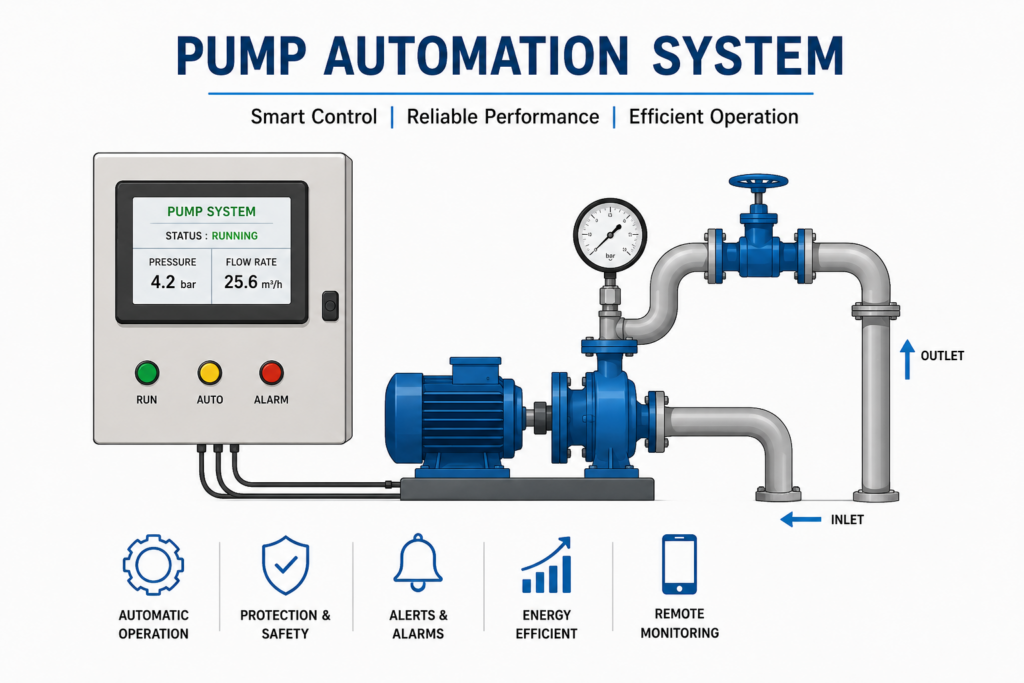
Water utilities, manufacturing plants and agricultural operations across India are using a pump automation system to solve a problem: they want to keep pumps running properly without someone always watching them. As these industries get bigger and spread out over areas, a pump automation system helps the people in charge control, monitor and protect the pumps without needing someone to be there in person all the time. This is not just about making things easier; it is about saving energy, preventing breakdowns and making sure water systems work exactly when they are needed and how they are needed.
What Is a Pump Automation System?
A pump automation system is something that uses sensors, controllers and communication modules to turn pumps on and off and adjust them based on what is happening in real time, like the water level, the pressure or the flow rate or the demand. If someone manually turns a pump on or off, the pump automation system looks at the current situation and makes a decision right away, usually more accurately than a person could.
This is really useful in India, where the pumping systems can be far apart from wells in rural areas to big pump houses in cities. The pump automation system takes out the guesswork. Reduces the risk of pumps breaking down, getting too hot or working in a way that is not safe. The pump automation system helps the people in charge of water utilities, manufacturing plants and agricultural operations to keep the pumps running properly and safely. The pump automation system is a help to these industries in India.
Why Industries Are Adopting Smart Pump Control Systems
A smart pump control system does a lot more than just turn equipment on and off. It checks the conditions all the time. Change the pump speed or order to match what is really needed. For example, in a water supply system, a smart pump control system can increase the pump speed during the time when people use the water and decrease it at night, which saves a lot of money on electricity without affecting the water supply.
Industries also like these systems because they reduce the need for people to work at places that’re far away. A smart pump control system can be set up with safety features, alarms and automatic shutdown, which protects the equipment from getting damaged due to no water changes in voltage or blockages.
The Role of Automated Pump Monitoring
Automated pump monitoring is what makes a pump automation system work well over time. Instead of waiting for a pump to stop working before anyone notices, automated pump monitoring checks things like vibration, electricity use, temperature and flow all the time. If anything is not normal, it can send an alert before a small problem becomes an expensive one.
For industries that run systems, such as sewage treatment plants or irrigation systems, automated pump monitoring gives an early warning that people cannot. It also keeps a record of how the equipment’s working, which is useful for planning maintenance and taking care of the equipment.
Industrial Pump Automation Across Sectors
Pump automation technology is applicable in diverse sectors in India. It enables farmers to manage water effectively in the agricultural sector by ensuring efficiency in water usage and availability to the crops. In manufacturing companies, it ensures proper functioning of cooling systems and processes to improve the quality of their products. In city infrastructure, it supports water treatment and sewage pumping stations that must work all the time with help from people. What makes pump automation very useful in India is its ability to work well with different power quality and challenging weather conditions, from very hot summers to heavy rains, while still working consistently.
IoT-Based Pump Management and Remote Visibility
Modern systems are using IoT-based pump management more and more, which connects each pump station to a dashboard that can be accessed from anywhere. With IoT-based pump management, the people in charge of the plants do not need to visit each site to see how the equipment is working. Instead, they can see the status, past trends and fault alerts from one screen, whether they are in the same building or far away.
This connection is closely related to the capabilities of pump monitoring systems, which allow engineers to identify problems, adjust settings, and even restart equipment without going to the site. A remote pump monitoring system is very useful for organizations that manage pump stations in areas where just travelling to the site can delay important repairs by hours or days.
Key Benefits: Why Pump Automation Matters for Your Facility
A pump automation system does more than switch pumps on and off. The protections built into the panel are what keep motors, pipelines, and pump stations running for years without breakdowns. Here is what these panels typically deliver.
Protects from Dry-Running and Motor Halts Before Burning
The borewell and submersible pump motors burn out in case of running in dry wells since the water flow in the motors is responsible for the cooling of the winding. Within several seconds, the panel registers no flow or low flow of water and switches off the pump prior to the winding burning.
Protection Against Phase Failure and Phase Imbalance
In case of a three-phase pump motor functioning under uneven phases, the extra current is drawn by the remaining two phases up to 40-50%. The panel detects phase failure, phase reversal and phase imbalance and switches off the motor within minutes before insulation degradation.
Auto Start / Stop on Tank Level
Electrode probes or float switches in the overhead tank and sump tell the panel exactly when to start and stop the pump. No manual switching, no overflow and no empty tank in the morning.
Auto-Changeover Between Duty and Standby Pumps
For sites that run duty-standby pump pairs, the panel automatically rotates duty to equalize run hours. If the duty pump stops working, the standby starts firing automatically, hence keeping the city or industrial supply operating continuously.
GSM / SMS Remote Control
This optional module allows the panel to start or stop the pump through SMS or a mobile application and also alerts the user when the pump trips or there is overflow of the tank. It is useful in farm borewells, remote water supply systems and buildings where no one is available.
Over-Current, Under-Voltage and Over-Voltage Protection
The control system checks the supply voltage continuously. Tripping on under-voltage prevents the motor from drawing excess current in case of low voltage, while tripping on over-voltage helps protect the motor in case of high grid feeder voltages.
AMSET Technology in Pune: Engineering Dependable Pump Solutions
AMSET Technology builds systems that can handle dust, heat, humidity and power supply issues, which are big problems at industrial and rural sites in India. This approach is what makes the company’s solutions work well for a long time, not just in a lab.
When a business is looking for this kind of technology, they should pay attention to the quality of the sensors, how strong the hardware is, how easy it is to connect with the existing pump system and how good the technical support is. If a system looks good on paper but cannot handle the conditions in India, it will cost more to fix it than it saves.