
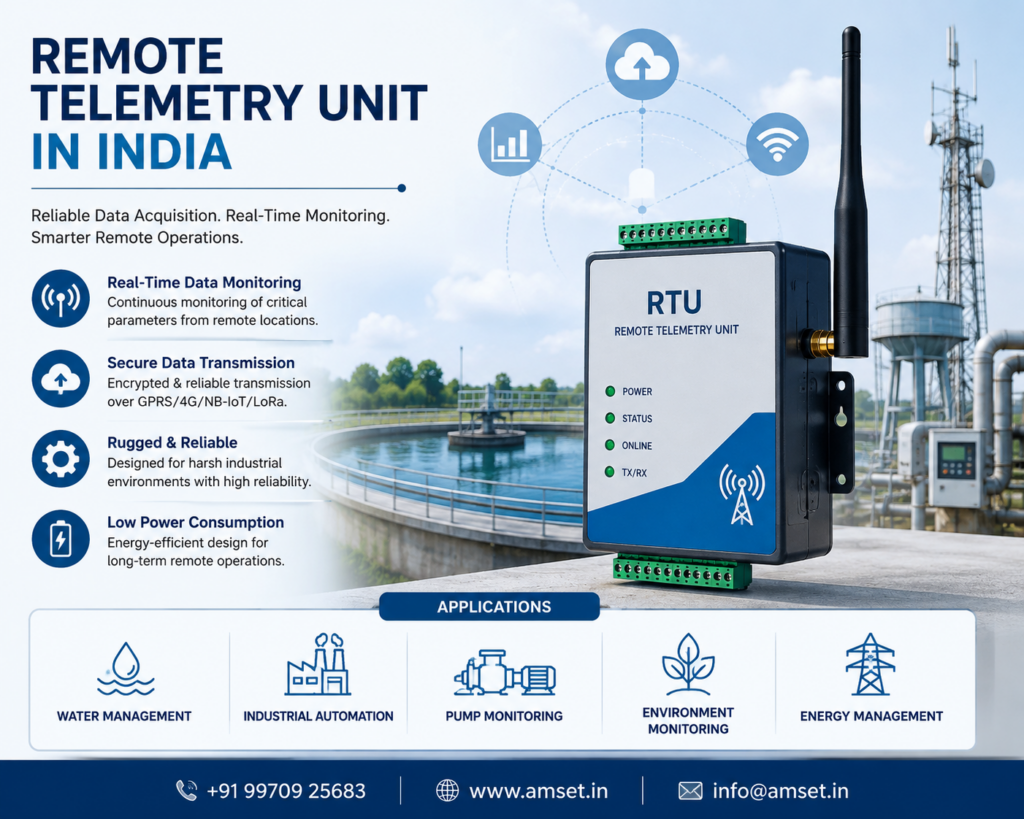
India has many industries located in remote areas. These places can be near rivers, on the coast or even in areas with limited access to water treatment. For a time, people had to drive for hours to check on equipment and infrastructure in these locations. They had to wait for someone to check on things now and then manually. Now a remote telemetry unit in India is changing the way people do things. These small devices are really tough. Can collect data from sensors in the field. Then they send that data to control rooms or cloud dashboards. This gives operators a look at what is happening regardless of where the equipment.
Why Remote Telemetry Matters Today
In India, many industries, such as water management, power, railways, and manufacturing, require data on time. If someone finds out about a problem late, it can result in lost production or safety risks or expensive downtime. This is where a remote telemetry unit in India is really useful. It helps connect the equipment in the field with the people who need to do something with the data, from the remote telemetry unit. The people can then use the data from the remote telemetry unit to take action. This can happen in seconds, not days.
Older systems used to require a lot of wiring, and people had to be on-site all the time. Modern telemetry units use things like GSM, LoRa, or satellite connectivity to send readings from almost anywhere. This is really important in a country like India, where plants in areas and plants on the coast have different connectivity challenges.
Core Features of a Reliable Remote Monitoring System
A remote monitoring system should do more than just collect numbers. It should have:
- Multi-parameter data logging, which captures things like flow and pressure and temperature and voltage or water quality readings
- Cloud-based dashboards so teams can check the status from a phone or laptop or by visiting the site.
- Alarm and alert configuration, which sends instant notifications when readings cross safe thresholds
- Battery backup and solar compatibility, which are essential for sites without stable grid power
- Rugged, weatherproof enclosures, which can handle India’s climate
When these features come together, the result is a system that does not just report problems after they happen. It helps prevent them.
Applications Across Industries
A remote telemetry unit in India is used in a lot of sectors. These include:
1) Water and Wastewater Management– Municipal and industrial water treatment plants rely on readings of flow rate, chlorine levels, and turbidity. A telemetry unit paired with a data acquisition system ensures operators know instantly if quality drops below standards.
2) Railways – Track and signal health monitoring has become more proactive thanks to telemetry-based systems that flag vibration anomalies or temperature spikes in real time. Power and Energy. Substations and transformers in areas benefit from constant voltage and load monitoring, cutting down on unplanned outages.
3) Agriculture and Irrigation – Soil moisture sensors and pump controllers connected through telemetry give farmers control over water usage even from a mobile phone.
4) Power and Energy – Substations and transformers in areas benefit from constant voltage and load monitoring, cutting down on unplanned outages.
5) Agriculture and Irrigation– Soil moisture sensors and pump controllers connected through telemetry give farmers control over water usage even from a mobile phone.
The Shift Toward Based Remote Monitoring
What sets today’s systems apart from the telemetry units of a decade ago is the shift toward IoT-based remote monitoring. Sensors are not isolated devices reporting to a single control panel. They are part of a network that feeds data into analytics platforms. This means trends can be spotted over weeks or months, not captured as a single reading.
Real-Time Data Monitoring Changes the Decision-Making Process
However, the most significant impact that telemetry has had on this industry has been the rapidity with which decisions can be made. Thanks to the real-time tracking capabilities that telemetry has introduced into operations, plant managers do not need to wait until the end of each day to determine if systems are functioning as expected. This has an impact on safety compliance, resource planning, and cost control.
AMSET Technology is a company that brings value. With a background in IoT and SCADA-based solutions, AMSET Technology designs remote telemetry systems tailored to the specific needs of Indian industries. Instead of offering a one-size-fits-all box, AMSET Technologies works with clients to configure the right combination of sensors, connectivity, and reporting.
The increased automation among industries in India will mean that the use of a remote telemetry unit in India will become very essential. Be it a water treatment plant or one on a railway line running through several states, the ability to monitor conditions from afar and react immediately is no longer optional. It’s becoming practice. Companies that invest early in telemetry infrastructure backed by experienced partners, like AMSET Technology, are better positioned to run safer, more efficient, and more resilient operations in the years ahead.