
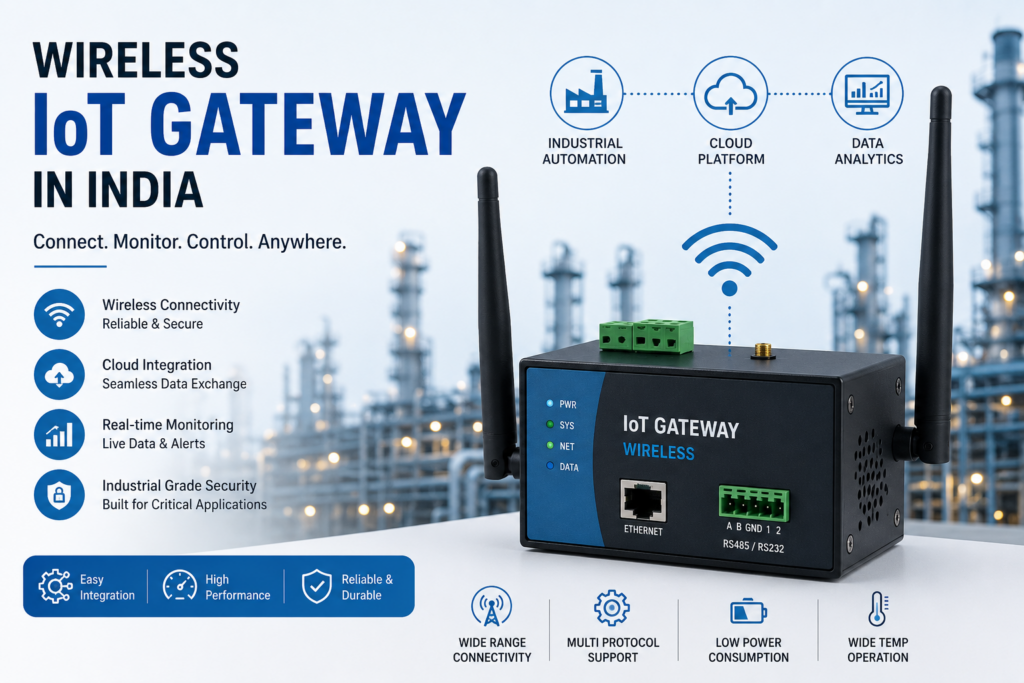
Every manufacturing plant produces large amounts of data: pressure values, flow levels, vibration data, and temperatures recorded, but only becomes valuable if it makes it into the right hands. And it is precisely such an issue that a wireless IoT gateway in India tries to address. Operating between sensors in the field and the monitoring system at the core of the solution, the device aggregates data coming from all sources and transmits it further, free from any costs, delays, or physical constraints of laying cables through a plant, a water treatment facility, or even a railroad. As Indian manufacturers are becoming increasingly smart and connected, the gateway has become a vital component of the whole system.
Why Wired Networks Fall Short
Laying cable across a large industrial site sounds simple until you actually try to do it. Trenching, conduit, junction boxes, and ongoing maintenance add up fast both in cost and in time. For facilities spread across several acres, or assets located in hard-to-reach places like remote pump houses or elevated railway signal points, wired connectivity often isn’t practical at all.
It is only now that the advantages of IoT connectivity solutions with wireless architecture become evident. In place of digging trenches and laying down conduits, the sensors transmit data via radio frequencies, cellular network, and even mesh protocol before transmitting to a gateway, which then transmits the data to either the SCADA system or cloud dashboard, or both. All this leads to faster installation, lower cost of setup, and increased flexibility when it comes to expansion or modification of a facility.
The Basic Functions of an IoT Gateway in India
A wireless IoT gateway in India has three basic functions to perform. First, it gathers the information transmitted by several different field devices. Second, it translates this data into a compatible form. Third, it passes that information further. Different types of field devices use different protocols to exchange data be it Modbus, LoRaWAN, Zigbee, or any other manufacturer-specific protocol. This translation layer matters more than people realise. Without it, operators would be stuck trying to manually reconcile data from a dozen incompatible devices. With a properly configured gateway, everything flows into one unified view, whether that view lives on a control room screen or a manager’s phone.
The Backbone: Wireless Data Transmission
None of this works without a dependable wireless data transmission system underneath it. Signal strength, network stability, and range all directly affect how reliable the entire monitoring setup turns out to be. In Indian conditions where a site might span dense urban infrastructure on one end and open rural terrain on the other transmission reliability can’t be an afterthought.
Good gateways are built to handle intermittent connectivity gracefully, buffering data locally when a signal drops and syncing it back once connectivity resumes. That way, a brief network hiccup doesn’t translate into a gap in critical readings. For sectors like water quality monitoring or railway infrastructure tracking, where missing even a few minutes of data could mean missing an early warning sign, this kind of resilience isn’t optional — it’s essential.
Selecting the Correct IoT Communication Gateway
All gateways are not created equal, and selecting the wrong one could result in the cancellation of many of the advantages provided by wireless communication technology. For an IoT communication gateway to function correctly, it must be able to support more than one protocol at a time, work well in different environments, and easily scale as sensors increase in the network.
This is an area where AMSET Technology has built genuine expertise. Working across sectors like railway monitoring and water quality analysis, AMSET Technology designs connectivity solutions that are engineered for real Indian field conditions rather than adapted from generic overseas templates. Their IR NIYANTRAC railway monitoring system and WQA-01 water quality analyzer both depend on this kind of dependable data transmission to function the way they’re meant to, collecting field readings and getting them to the right dashboard without dropouts or delays.
By focusing specifically on a wireless IoT gateway in India built for local infrastructure realities, AMSET Technologies helps industries avoid the common pitfall of importing hardware that looks good on paper but struggles once it’s actually deployed on the ground.
Real-World Applications Across Sectors
A few areas where wireless gateway technology is already making a measurable difference:
- Water treatment and distribution gateways relay real-time water quality data from remote analyzers, allowing operators to catch contamination or process issues early.
- Railway systems signals and track condition information are fed from field sensors to control centres continuously, ensuring enhanced efficiency and safety.
- Factory data is provided from machine sensors to production dashboards without laying additional cabling in the factory floor.
- Utilities and energy substations and distributed assets stay connected without the enormous cost of running physical cable networks across wide service areas.
With the adoption of connected infrastructure in industries in India, there will be an ever-increasing need for a robust and secure wireless IoT gateway solution in the country. Organizations that get this aspect right will ensure smooth scalability, efficient connectivity, and a monitoring system that can be relied upon. AMSET Technology, among other organizations, is working towards narrowing this gap by developing gateway solutions that take into consideration the Indian landscape and power requirements.
For any organization planning its next phase of industrial automation, choosing the right gateway isn’t a small technical detail; it’s the foundation everything else gets built on.